
Current Steel Price Development 2026 – Prices, Forecasts and Market Trends
Note: The term “steel price” does not refer to a single global market price. Prices can differ considerably depending on product, region and delivery terms. Hot-rolled coil, rebar, steel beams, plates, scrap and stainless steel follow similar market mechanisms, but they are not traded at identical prices.
This article gives you an up-to-date overview of steel price development in 2026, with a particular focus on European hot-rolled coil prices, prices for steel beams, plates and sections, international price differences, key influencing factors and the question of whether steel prices can be traded on an exchange.
After the sharp rise in the first quarter of 2026 and a correction in early summer, European hot-rolled coil prices have been rising again since July and are now above their spring high. On 21 Oct 2026, LME Steel HRC NW Europe (Argus) was quoted for the November contract at 829.49 USD/t, equivalent to around 738 €/t. For steel beams, plates and sections in larger quantities, this currently results in a price range of around 0.90 to 1.00 €/kg.
- Europe: hot-rolled coil most recently at around 740–750 €/t (LME November contract on 21 Oct 2026; SteelBenchmarker Western Europe 749 €/t ex works on 12 Oct 2026).
- USA: HRC prices remain at a very high level, most recently at around 1,310 USD per tonne ex works (SteelBenchmarker, east of the Mississippi, 12 Oct 2026).
- China: a significantly lower price level, with domestic prices most recently at around 422 USD/t ex works; export material on the world market at around 490 USD/t FOB (SteelBenchmarker, 12 Oct 2026).
Overall, the steel market in 2026 remains characterised by marked regional price differences. The gap between Europe, the USA and China continues to stand out in particular.
Current steel prices on the commodity exchange
The most important exchange-traded indicators relate mainly to hot-rolled flat steel, i.e. hot-rolled coil (HRC). These prices are particularly relevant for the automotive industry, mechanical engineering and industrial processing.
For steel beams, steel sections or individual cut-to-size plates, on the other hand, there are no direct exchange quotations. In practice, however, these prices often correlate with the development of hot-rolled coil, scrap, energy prices and transport costs. For construction projects, a steel price index can also be helpful, especially in the case of variable prices.
On the London Metal Exchange, LME Steel HRC NW Europe (Argus) stood on 21 Oct 2026 at 826.71 USD/t for the October contract and at 829.49 USD/t for the November contract. The contract is quoted in US dollars per tonne and reflects the Argus price for hot-rolled coil ex works in North-West Europe. You can follow the current price chart directly on the LME website.
Converted using the ECB reference rate of 21 Oct 2026 (1 EUR = 1.1234 USD).
Which steel prices are there?
There is no such thing as “the” steel price. Different reference prices are used depending on the product and region. This is why very different figures for the steel price can be found online.
- HRC / hot-rolled coil: an important reference price for industry, mechanical engineering and automotive suppliers.
- Rebar / reinforcing steel: particularly relevant for the construction industry and concrete reinforcement.
- Steel scrap: an important raw material for electric arc furnace steelworks and recycled steel.
- Steel beams and sections: usually no direct exchange quotation, but stockholder and mill list prices.
- Stainless steel: heavily dependent on alloying metals such as nickel, chromium and molybdenum.
HRC prices are often a good indicator of general steel price development. For specific orders, however, product type, dimensions, quantity, delivery location and surface finish are always decisive. Prices from online shops for single items and small quantities are not a suitable benchmark for industrial procurement.
Prices for steel beams, plates and sections
Jactio price band October 2026 · beams, plates and sections, larger quantities
900 – 1,000 €/t · 0.90 – 1.00 €/kg
Guide values for structural steel such as S235/S355, ex works and excluding freight. Updated monthly.
At present, prices for heavy beams, heavy plates and sections in larger quantities are roughly in the range of 900 € to 1,000 € per tonne. The exact price depends heavily on steel grade, dimensions, surface treatment, origin, order quantity and delivery terms.
- Thinner plates, special sections and smaller quantities are often at the upper end of this range or above it.
- For galvanised, coated or urgently required materials, effective purchase prices can be considerably higher.
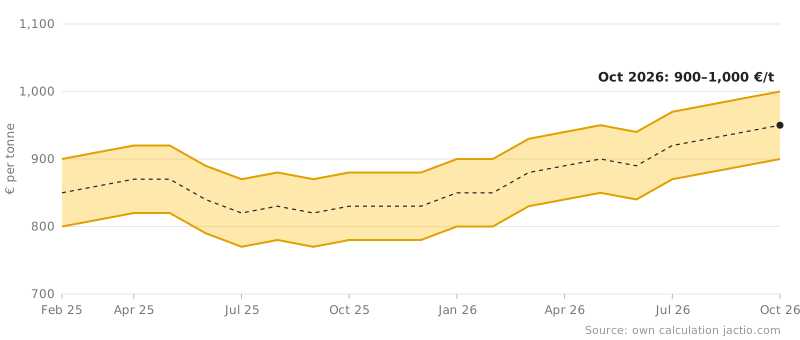
Show monthly values of the price band
| Month | € per tonne | € per kg |
|---|---|---|
| October 2026 | 900 – 1,000 | 0.90 – 1.00 |
| September 2026 | 890 – 990 | 0.89 – 0.99 |
| August 2026 | 880 – 980 | 0.88 – 0.98 |
| July 2026 | 870 – 970 | 0.87 – 0.97 |
| June 2026 | 840 – 940 | 0.84 – 0.94 |
| May 2026 | 850 – 950 | 0.85 – 0.95 |
| April 2026 | 840 – 940 | 0.84 – 0.94 |
| March 2026 | 830 – 930 | 0.83 – 0.93 |
| February 2026 | 800 – 900 | 0.80 – 0.90 |
| January 2026 | 800 – 900 | 0.80 – 0.90 |
| December 2025 | 780 – 880 | 0.78 – 0.88 |
| November 2025 | 780 – 880 | 0.78 – 0.88 |
| October 2025 | 780 – 880 | 0.78 – 0.88 |
| September 2025 | 770 – 870 | 0.77 – 0.87 |
| August 2025 | 780 – 880 | 0.78 – 0.88 |
| July 2025 | 770 – 870 | 0.77 – 0.87 |
| June 2025 | 790 – 890 | 0.79 – 0.89 |
| May 2025 | 820 – 920 | 0.82 – 0.92 |
| April 2025 | 820 – 920 | 0.82 – 0.92 |
| March 2025 | 810 – 910 | 0.81 – 0.91 |
| February 2025 | 800 – 900 | 0.80 – 0.90 |
Why are steel prices lower in China than in Europe?
A common comparison shows marked price differences between China, Europe and the USA. For many steel products, China has lower reference prices than Europe. Reasons include large production capacities, lower cost structures, strong export pressure and different market regulation.
In Europe, by contrast, higher energy prices, stricter environmental requirements, CO₂ costs, transport costs and trade policy measures push prices up. In addition, import quotas, anti-dumping measures and the Carbon Border Adjustment Mechanism (CBAM) make a direct comparison between Asian and European steel prices more difficult. CBAM has been in its definitive phase since 1 January 2026, and since 1 July 2026 a permanent EU safeguard measure has applied, with significantly smaller duty-free import quotas and a 50% tariff outside the quotas.
A lower Chinese steel price therefore does not automatically mean that buying in China pays off. In practice, freight, customs duties, lead time, minimum order quantities, quality assurance, material certificates, standards, currency risks and possible complaints must also be taken into account.
For standard material in very large quantities, China can be an attractive option. For many European projects, short-notice requirements or components where standards compliance is critical, however, buying directly in Europe or from established trading partners is usually much easier to calculate.
Which factors influence the steel price?
Steel prices are influenced by several markets at the same time. Besides supply and demand, raw material costs, energy prices, currencies and the political environment play a major role.
- Energy prices: steel production is energy-intensive. High electricity and gas prices increase production costs.
- Iron ore and coking coal: important raw materials for conventional primary steel production.
- Steel scrap: particularly important for electric arc furnace steelworks and recycled steel.
- China: demand, exports and production policy in China have a major influence on the world market.
- Tariffs and trade restrictions: import quotas, anti-dumping measures and CBAM influence regional prices.
- Economic cycle: construction, mechanical engineering, the automotive industry and infrastructure projects determine demand.
This is why the steel price is often regarded as an economic indicator. Rising steel prices can point to strong industrial demand or supply shortages, while falling prices can indicate weaker demand or overcapacity.
What does the steel price say about the economy?
Steel is used in many key industries: construction, mechanical engineering, the automotive industry, energy, infrastructure, plant engineering and logistics. As a result, steel prices often react sensitively to changes in the general economic situation.
A rising steel price can indicate robust demand, higher energy and raw material costs or tight production capacities. A falling steel price, on the other hand, can point to weaker demand, falling raw material costs or overcapacity. However, 2026 shows that trade protection can support prices in Europe even when demand is weak.
For market observers, the steel price is therefore not just a material price but also an indication of how industry, construction activity, energy prices and global trade are developing.
Can steel prices be hedged or traded on an exchange?
Steel prices can in principle be hedged, but not as easily as gold, silver or oil. The reason: steel is not a uniform commodity. Prices differ depending on product, region, grade, dimensions, surface finish and delivery terms.
Nevertheless, commodity exchanges offer tradable contracts on certain steel products, for example hot-rolled coil (HRC), rebar, scrap or regional reference prices. These contracts can give an indication of market expectations and are in some cases also used for hedging.
Companies have three typical ways of hedging steel prices:
- Price adjustment clauses: the project price is linked to a steel price index. In steel construction, this is often the most practical solution.
- Framework agreements or fixed prices: suppliers guarantee prices for certain quantities or periods, but usually build in a risk buffer for this.
- Financial hedging: part of the price risk can be hedged using futures or other financial instruments. However, a basis risk often remains, because the traded contract does not exactly match the material actually required.
Private investors can trade steel prices directly only to a limited extent. Instead, they more often follow broader commodity markets, energy prices, indices or industrial metals such as copper and aluminium. These markets influence steel price development indirectly and are usually easier to access than specialised steel contracts.
How do steel prices affect steel construction projects?
Steel prices remain an important factor in the cost of steel structures. At the same time, labour costs, energy costs, transport costs, surface treatment and fabrication complexity play a major role in steel construction projects.
In low-wage countries such as Turkey and the Balkan countries, simple, heavy steel structures can currently be fabricated from around 1.75 €/kg, unpainted, ex works. Complexity, surface treatment and logistics often influence the final price more than the steel price itself.
For galvanised components, painted structures, one-off items or ready-to-install assemblies, the material price is therefore only one part of the overall cost calculation. The article Cost factors in steel construction shows which cost factors come together here.
Steel price forecast 2026 – a firm market after the summer
After the sharp rise in the first quarter of 2026 and a correction in May and June, the European hot-rolled coil price has firmed again since July. This is driven mainly by the EU’s tightened import protection rather than by demand.
Short-term outlook:
- The LME prices for October (826.71 USD/t) and November (829.49 USD/t) are almost level. In the short term, this points to sideways movement rather than a further sharp rise.
- Since 1 July 2026, the EU’s duty-free import quotas have been cut by around 47%, with a 50% tariff applying beyond them. Since 1 October 2026, the place of melting must also be proven. This supports prices in Europe.
- Experience shows that stockholder and mill prices for beams and sections follow hot-rolled coil prices with a lag of a few months. The rise since the summer has therefore not yet been fully passed through to purchase prices.
- For beams, plates and sections, a range of around 0.90 to 1.00 €/kg appears plausible in the short term, tending towards the upper end if hot-rolled coil prices remain firm.
- Demand remains weak: worldsteel expects a slight decline in EU steel demand of 0.3% in 2026 and a recovery of 3.1% only in 2027.
- Energy prices, tariffs, geopolitical risks such as the conflict in the Middle East, and transport costs remain key uncertainties.
For buyers, this means: long-term fixed prices remain difficult. Short validity periods for quotations, regular market monitoring and, for larger projects, price adjustment clauses where appropriate make sense.
Frequently asked questions about steel prices
Where can I find current steel price information?
Current steel price information is available from sources including the London Metal Exchange (LME), steel price indices and market reports from steel stockholders and trade media. Exchange-traded data often relates to hot-rolled coil, rebar or scrap and not directly to steel beams or sections.
How much does a kilogram of steel cost?
For beams, plates and sections in structural steel grades, prices for larger quantities are currently around 0.90 to 1.00 €/kg (900 to 1,000 € per tonne), ex works and excluding freight. Small quantities, cut-to-size parts, special grades and surface treatments are correspondingly more expensive.
Which factors influence steel prices?
The most important influencing factors include energy prices, raw material prices, scrap prices, demand from construction and industry, production capacities, tariffs, transport costs and exchange rates.
Are there reliable forecasts for future steel prices?
Steel price forecasts are always uncertain, as geopolitical events, energy prices, slumps in demand or trade restrictions can change the market at short notice. Futures contracts and steel indices give an indication of market expectations but are no substitute for a reliable price commitment.
How often are steel prices updated?
Exchange-traded steel prices and futures contracts are updated continuously or daily on trading days. Many price indices for steel beams, sections or construction products, on the other hand, are published only monthly or with a delay. This is why current exchange prices and published steel price indices can differ. We update the price band in this article monthly.
Can steel be traded like gold or silver?
Steel is much harder to trade directly than gold or silver. There are futures and reference prices for certain steel products, but these are more specialised and less accessible. Private investors therefore often follow broader commodity markets, energy prices or industrial metals that are linked to steel price development.
How is the price of structural steel developing?
Structural steel is a collective term for unalloyed steels used in construction and mechanical engineering. It includes steel beams, sections, plates and reinforcing steel, among others. Prices broadly follow general steel price development but can differ considerably depending on the product group.
Why do steel prices differ by region?
Regional differences arise from energy prices, demand, local production capacities, transport costs, tariffs and trade restrictions. The gap between China, Europe and the USA is particularly pronounced at present.
Why not simply buy steel in China?
The pure steel price is often lower in China. For European buyers, however, freight, customs duties, lead time, minimum order quantities, quality documentation, standards, currency risks and complaint risks come on top. Chinese steel is therefore not automatically cheaper or more practical, especially for smaller quantities or projects where standards compliance is critical.
What impact do steel prices have on industry?
For many industrial companies, steel is a key cost factor. Rising steel prices make machinery, steel halls, assemblies, vehicles and capital goods more expensive. Falling prices, on the other hand, can improve the competitiveness of steel-intensive products.
Further information
- Steel price index – overview of price development for various steel products.
- Price adjustment clauses in steel construction – how price changes can be taken into account contractually in projects.
- Cost factors in steel construction – which factors besides the material price influence the total costs.
- Corrosion protection of steel – overview of galvanising, coating and other protection methods.
Sources of the individual values cited: London Metal Exchange (LME Steel HRC NW Europe, Argus), SteelBenchmarker™ (World Steel Dynamics), European Central Bank (reference rates), worldsteel, European Commission. The Jactio price band is our own calculation.
Last revised on 23 October 2026 by Andreas Janisch